
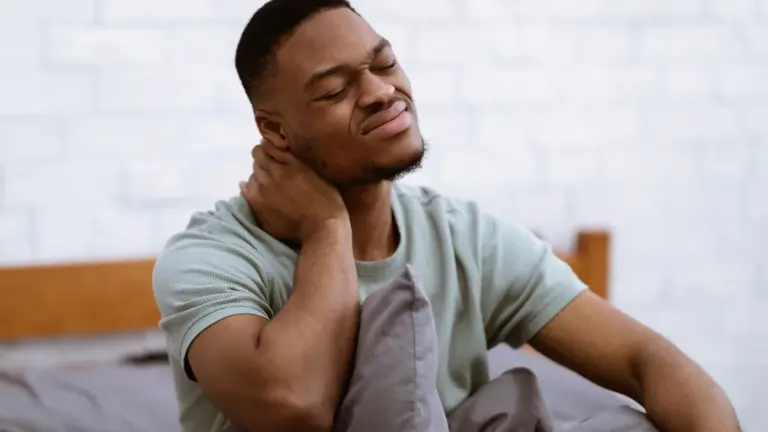
Where neck pain comes from
Your head weighs roughly as much as a bowling ball and sits on top of seven small vertebrae held in place by muscle. That arrangement works well when the head is balanced over the shoulders. It works considerably less well when the head is carried forward, which is where most people spend their day.
Every inch the head travels forward multiplies the load the neck muscles have to hold. Hours at a monitor set too low, a laptop on a kitchen table, a phone cradled against a shoulder and driving with the seat too far back all produce the same pattern: joints at the base of the neck stop moving properly, and the muscle across the top of the shoulders takes the strain.
The other common origin is a collision. Whiplash loads the neck in a direction it cannot resist, and it is covered on our whiplash page.
Get urgent medical care instead if you have
- Loss of bladder or bowel control
- Numbness around the groin or inner thighs
- Progressive weakness in a leg or arm
- Pain after significant trauma
- Fever with back pain
- Unexplained weight loss with back pain
These need assessment now rather than a chiropractic appointment. Go to an emergency department or call your doctor.
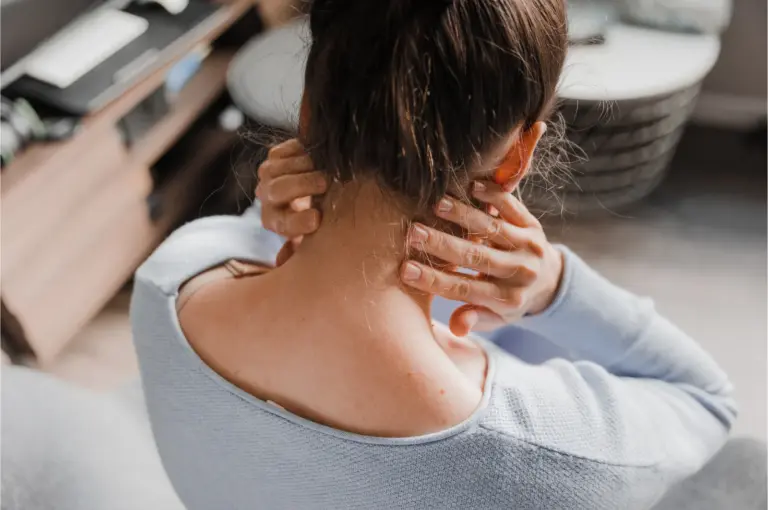
When pain runs into the arm
Neck pain that stays in the neck and shoulders is a different problem from neck pain that travels. Pain, pins and needles, numbness or weakness running down an arm suggests a nerve root is being irritated, usually by a disc or by narrowing where the nerve exits the spine.
That changes the treatment. Where a disc is involved, spinal decompression is often part of the plan alongside adjustment. Progressive weakness or loss of grip is a reason to be assessed promptly rather than booked in next week.
The headache connection
A large share of the headaches we treat begin in the neck rather than the head. The upper cervical joints and the suboccipital muscles at the base of the skull refer pain up and over the scalp, often behind one eye. Patients frequently describe it as a migraine, and it responds to treatment aimed at the neck rather than to headache medication.
Not sure if this is what you need?
Call the clinic and we will tell you whether this is something we treat.
How we treat it
Adjustment restores motion to the restricted joints. Soft tissue work to the upper trapezius, levator scapulae and suboccipital muscles releases the guarding, which matters more in the neck than almost anywhere else because those muscles are what refer pain into the head.
Then there is the part you take home. Monitor height, chair position, how you hold a phone and how you sleep are the things that either maintain the improvement or undo it by Thursday. A pillow that holds the neck in line with the spine rather than propping it up at an angle is one of the cheapest useful changes most patients can make.
Sleeping position
You spend about a third of your life in one position, so it is worth getting right. Side and back sleeping both work if the pillow holds your head level with your spine rather than propping it up or letting it drop. Front sleeping is the difficult one, because it requires the neck to be rotated close to its end range for hours at a time, and patients who wake with neck pain most mornings are very often front sleepers.
Pillow height matters more than firmness. Broad shoulders need more loft when side sleeping, and a back sleeper generally needs less than they think.
Booking
Call 918-615-3433 to book an examination for neck pain in Tulsa.
The information on this site is general and is not medical advice. It does not replace a consultation with a licensed provider. Individual results vary.